Wednesday, March 23, 2016

CHINESE SPORTS.

CHINESE SPORTS.
NATIONAL FESTIVAL. ANNIVERSARY OF FOUNDING OF REPUBLIC. The Chinese community of Christchurch kept holiday yesterday, the nineteenth anniversary of the Chinese Republic, which was, founded after the fall of the Manchu Dynasty in 1911 The celebration took the form of a picnic and sports meeting at English Park. He festival is given the name the Double Tenth because it took place on the tenth day of the tenth month of the European Calendar this calendar was adopted after the revolution, which also inaugurated a greater measure of adoption of European customs than had been the rule under the former rulers. At English Park yesterday the festival was opened by Mr Yee Gam, the presidents of the Chinese Sports Committee. who addressed the Chinese, numbering about 60 who were present. The interpreter explained to the Europeans present that the speech referred to the services done for China by Dr, Sun Yat-sen, who was the principal figure of the revolution. Apart from the sports events, which followed immediately after the speeches, the principal feature of the afternoon was the Association football match, played between the Chinese team and the Marist junior team This resulted in a win for the Europeans by 5 goals to 4, after a closely contested game. There was a large attendance of Chinese from all surrounding districts including representatives from Wellington, Dunedin. South Canterbury and Westland. All of those present were entertained at afternoon tea. and a touch of colour was lent to the gathering, which was large in spite of the bad weather conditions, by the Chinese banner of welcome and the flags British and Chinese which flew above the grounds.
The whole of the gate takings are as has been the custom, to be given to the Christchurch Public Hospital All the expenses of the meeting were borne by the Chinese community. The officials for the sports were President Yep Gam; K. N Lowe: interpreter Eric Chun-. starters W. L Kee and Willie Tims; and judges. Harry Wong and Chan S Wah: Chinese announcers Norman Lim and Y Yak; organiser George Ah Chang and treasurer Fred Young. The sports results as follows: Three-legged Race —George Ah Chang and George Yee 1, Kwok Bros 2. Backward Walking Race—Harry Kwok 1, Arthur Yee 3. Net to Net Race—Harry Kwok 1, F. Floy 2. Thread-the-Needle Race—Harry Kwok I, George Yee 2 Egg and Spoon Race—George Yee 1 A. Kwok 2. European's Race—E. Harper 1, R Gib bons 3. Slow Cycle Race—Arthur Teo. Children's Race —Irma Lowe 1, Joyce Tim 2 Bicycle Race—Arthur Yee 1, Fook Hor 3. Europeans' Bicycle Race C C  Allen 1. Flint and Smith 3
Football Match. The football match, won by Marist, 6-4, was evenly contested throughout, although, the Marist. team had the advantage of the play -in the second half. The teams were: Chinese: George Shue. Percy Lowe, George Yee, Arthur Yee. Yea Too,.F. Loy, Harry Kwok, Allan Kwok, Willie Chong Lee. George Ah Chang (captain), and J S. Tom. Marist: W. Barrett, Fullen, F. Tool, C. Hull, B. Porter, P. Watts. L George, C Grimes (captain), M. George, J. Porter, and D Sellers. The first spell ended with the score 3-2 in favour of the Chinese team, but in the second spell Marist scored three goals and the Chinese only one, a penalty The scorers for Marist were J. Porter (2). C Hall, L. George, and T Grimes, and for the Chinese, Harry Kwok 3.Willie Chong Lee, and Allan Kwok" After the match the prizes won were presented by Mr Yee Gam Following this many of the Chinese returned- to the City in beflagged motor-cars, making a gay procession. Press, Volume LXVI, Issue 20056, 11 October 1930, Page 5


http://paperspast.natlib.govt.nz/cgi-bin/paperspast?a=d&cl=search&d=CHP19301011.2.23&srpos=6&e=-------10--1----0percy+ah+chang--
Press, Volume LXVII, Issue 20363, 9 October 1931, Page 18

Saturday, February 20, 2016

Chinese soccer

 The local Chinese Hamilton are making great preparations for the reception of the Chinese University Soccer team, who are to play South Auckland, at- Hamilton, on August 20. The team will arrive on the 19th and will be taken for a motor drive in the afternoon. in the evening, at 6 o'clock, a dinner will be tendered to them by the local members of the Kuo Min Tang (Chinese Political Party) after which a Chinese operetta will be staged with Chinese music and magical turns by Mr. Yeng, the secretary Later in the evening a real Chinese supper comprised of Oriental dishes will be served. Mr. H. K. Leong. the president of the local branch of the Kuo Min Tang, is in charge of arrangements.  Hawera & Normanby Star, Volume XLVIII, 8 August 1924, Page 9

Sunday, December 27, 2015

IN THE BANKRUPT ESTATE OP AH LSB CHGS YUNG, OF WBSTBROOK, STOREKEEPEB. lIHEEEBY give notice that I have tbis day SOLD to MR OHOW FONG of Grejmouth, Storekeeper, the whole of the Book Debts ia tbe Bankrupt Estate of Ah Lee Chee Young of Westbrook, Storekeeper. B. W. WADE, Deputy Official Assignee. Hokitika, Nov., 19,h, 1891- With reference to the above I hereby give notice that all the persons indebted to the above estate whose names appear below are requested to pay the amounts ef their several accounts at once. CHOW FONG. s, d. Lbih Mow 610 6 Yip Gne 2 2 6 Kttifi Ohon 3 8 6 Kum Com Yick 3 8 6 Lnm Cbun 3 8 6 Char Dick 6 8 6 Gan Why 15 0 Joe Mo Young 28 10 6 FongLoon 16 0 0 Good Lam 10 15 8 Pong MeeYing 810 1 Pong Sum mi 212 2 Chung Jiry 416 6 Yip May 2IS 0 Loo Song 16 6 Tbung Ing Patty 618 6 Yee Sing 12 0 Piog Gee 114 0 Ohtftf Hong Gae Party 32 2 6 Gu Chin 4 3 6 Chnn Yee Dick £12 6 Ohoo Hong Gue 15 6 Joy Yee 017 6 Young Head 113 0 hil Gow 015 6 Choo Cbar 012 0 Chung Ja'c' Sbing 3 3 0 CKun^Look 310 0 Ohing Young Que 015 0 Chung Kiim Sing 210 0 Chung Plilg Lai Party 9 5 6 Chung Nu 2 0 0 Chung Churi 013 0 Gue Him 16 0 Hoo Sing 0 6 0 Chun Chin 0 9 6 STing Otaun 0 4 0 Sou Son 0 5 0 Loo Ying 0 8 0 Sim Kin 0 3 0 Yick Chin 0 3 0 Kon Cho 110 0 Gan Kum Gee 0 6 C Lock Ham 7 10 Char Yu Party 27 9 0 Obor Yu 216 0 Lum Me Hune Party 10 12 6 KumCbin 311 v Kum Ping Ling 311 0 Ing Vim and Char Wy 7 0 0 Chum 100 Par y 910 0 Cue Loo Hung 412 6 lee Huny 12 6 JneDic* Sing 216 0 Joe Dick 110 0 In? T> iro .u~ 219 0 Won Gow 27 11 o <Jhur° Yin JJji.ek 13 211 ObeWhaKon 3 2 6 Charly Chun Ing 4 2 (5http://paperspast.natlib.govt.nz/cgi-bin/paperspast?a=d&d=WCT18911120.2.10.1&cl=search&srpos=8&e=-------100--1----0sing+lee+hawera--&st=1 West Coast Times , Issue 9179, 20 November 1891, Page 3

Friday, August 21, 2015

WW2 survivor’s search for Bahau, and closure


WW2 survivor’s search for Bahau, and closure


A war survivor and POW camp baby, Christina McTaggart-Tie Kim Nyong, 66, continues to research and spread the word about the Bahau POW camp in Malaysia during WWII. Jo Lo from Auckland City Libraries attended Christina's talk and interviewed her later about Bahau, where hundreds died from starvation, hardship and disease.
The rain was pounding down hard last Friday (21 May) as I beelined my way into Avondale Library to listen to Christina McTaggart's World War 2 experiences.
Christina McTaggartChristina was the first baby to survive Fuji-go (‘Fuji Village’), a Catholic resettlement colony (also known as a prisoner-of-war camp) in Bahau, West Malaysia, during the Second World War.
It was a fearful time, and Christina’s immediate family members decided to move north from Singapore to the Malaysian settlement to escape ill-treatment by the Japanese.
Despite high infant mortality rates in Bahau, Christina was born healthy. She was only 18 months old when the war ended, so her stories have been handed down by her mother Hilda, now 91.
The colony, split into ‘camp 5’ for the Chinese and ‘camp 6’ for the Eurasians, offered protection and safety to its people.
“Otherwise you were ‘outside’ and risked being captured and tortured by the Japanese.”
Many men were interrogated and suffered a terrible fate, and one of Christina’s uncles was arrested, tortured and killed because he worked for the British government.
Starvation and malaria were the biggest killers in Bahau, claiming between 300 and 1500 lives. However, the settlers were allowed to roam freely as long as they behaved and stayed well within the boundaries.Bahau resettlement camp
“We were treated well as long as we worked hard to grow food – it was a time of survival.”
While it’s notoriously difficult to get war information out of the elderly Chinese, Christina has been documenting her mother’s stories for 20 years.
Christina’s uncle was 10 when they were in the camp. Now 76 and living in Melbourne, it was initially impossible to obtain any information from him.
“It was a very sad time. Whenever I asked, he always said, ‘I don’t want to talk about it.’ He always wanted to forget about that part of his life.”
Christina and her cousin have been tenacious with the questioning, and the uncle has only begun to open up, in part due to the cousin having started researching the family’s history.

Beyond Gallipoli, and reliving history for future generations

Keeping people informed, and history alive, are the reasons behind Christina’s speaking engagements about Bahau. She wants to hand down her mother’s courageous stories of survival – not only to her own two children and six grandchildren – but to anyone who wants to know about the war heroes and survivors beyond Gallipoli and WWI.
“There were lots that happened to other people all over the world during the Second World War too.”
She wants to get people like her uncle “to come out of the woodwork.”
Compared with the Holocaust or China's Nanking massacre -- dubbed ‘the forgotten Holocaust’ by the late Iris Chang 
in The Rape of Nanking -- the horrors in South-East Asia during the Japanese invasion are not as well known.
How the younger generations are being told about Japan's WWII involvement in its schools is still controversial. This significant chunk of history has, for decades, been hugely distorted or whitewashed in the country’s high school textbooks to the point that some Japanese are clueless about the war crimes which occurred.
“When I went to Japan and stayed with the families, I was given VIP treatment. But if you ever said anything [about the war], they would say to me, ‘No, it can’t be.’ It’s because they were not told.”
Christina will be doing two more talks in Auckland before heading off to Malaysia and Singapore at the end of June. She’ll be visiting her mother who’s turning 92 soon, and meeting up with a historian, Fiona Hodgkins, whose mother was also at the Bahau camp.
My jaw dropped when she admitted she’d never once been back to Bahau since 1945.
“I’ve always wanted to go! They [sic] have opened up so much more about Bahau. I’ll be taking photos and finding out all about camp 5 – Mukim 5 – my camp.”
She will dig deeper about other settlement camps – for instance, the whereabouts of camps 1 to 4 in Bahau if they existed – in her quest to piece together the Bahau jigsaw.
“I want to write about Bahau and the war. I have memoirs from a priest who was at the camp. He’s dead now, but I’ve got 80 pages and would like to get this documented.”
And hopefully, what Christina unearths will soon be turned into a valuable source of information about what happened in South-East Asia during the Second World War.

If you would like to get in touch with Christina McTaggart-Tie about her experiences or research on the Bahau camp, please email her at Kimnyongm0@gmail.com

Recommended books about Singapore, Malaysia and WW2

Related links

Articles on Christina McTaggart:
Ebook containing information about Bahau:
 http://chinesecommunity.org.nz/family_history/topics/show/186-ww2-survivors-search-for-bahau-and-closure

Migrant works to honour war heroes

Migrant works to honour war heroes

Christina McTaggart was born in a Japanese prisoner-of-war camp. Photo / Brett Phibbs
An Auckland widow born in a Japanese prisoner-of-war camp has made it her mission to highlight New Zealand World War II heroes of the Pacific.
Christina McTaggart, 66, gives regular talks about her family's war time ordeal "to keep it real" for Kiwis.
Her next talk will be at the Avondale Library tomorrow morning, where she will share her story of being the first baby to survive the jungle hell in Fuji-go, a resettlement camp set up in what was then Malaya in 1943 by the Japanese military authorities.
A recent AUT University study suggests interest in Anzac Day is likely to decline over time.
Historian Professor Paul Moon found that an increase in the number of immigrants, without an understanding of the significance of Anzac Day, would also contribute to that decline.
Mrs McTaggart, originally from Singapore, said treating Anzac Day as "a day we honoured all Kiwi heroes who fought in all wars" would make the day more meaningful, especially for new migrants who knew little about Gallipoli.
▾ Advertising ▾
Close ad
She said it was important for Kiwis to learn about what happened in other wars our soldiers have fought, including in Malaya.
Mrs McTaggart said she was too young to remember or understand anything about what went on, but her mother never stopped telling her stories about the war.
One that was often told was about the time Singapore fell to the Japanese and the interrogation of men that followed.
"They were tortured, burned with cigarettes, their heads held under water and they were beaten until they talked. If they worked for the British, they were taken away and killed."
But she remembers one happy tale her mother told.
"It is about how the New Zealand and Australian forces came, as bearers of good news, bringing food to the village and the news that the Japanese had surrendered," Mrs McTaggart said.
"Since young, I have always had a warm feeling about the New Zealand and Australian Army because of that story. I think those who died in Malaya should be remembered just as much as those who fought in the battle of Gallipoli."
Mrs McTaggart's mother, Hilda Wee, now 91, still lives in Singapore.
During the Japanese occupation, at least 300 people in her village died, mostly from malnutrition, beri-beri, malaria and other insect-borne diseases.
"I don't think many in this new generation can imagine the horrors of war," Mrs McTaggart said.
"Death is just an integral part of it, and those who were not killed or tortured to death died of starvation because there was not enough food," she said.
"My family did not starve, but the less fortunate people had to eat whatever they could find, such as wild fowl, snails, frogs and cats. My mother had to enter the jungle to catch monitor lizards, which were a delicacy."
Mrs McTaggart moved to New Zealand in 1971 after she married naval architect Daniel McTaggart. He died six years ago.  http://www.nzherald.co.nz/lincoln-tan/news/article.cfm?a_id=308&objectid=10646145

Monday, January 6, 2014

Constable Tess is top of the cops

Constable Tess is top of the cops

Being a star nothing new for top recruit

SHELLEY NAHR
Last updated 05:00 07/10/2011


Share

Enter Your Zodiac Sign to Find Out Your Future. So Accurate its Scary!
Success is nothing new for Tess Kai Fong, 18, who has again risen to the top, beating 268 police recruits to take top spot at their graduation.
Constable Kai Fong received the Minister's Prize from Police Minister Judith Collins at Porirua yesterday for being top of her wing, as well as the Ericsson Practical Prize for overall winner in practical assessments, skills files and fingerprinting.
The Auckland-born-and-bred teenager, who was deputy head girl and deputy dux at Rangitoto College, was given the chance last year to visit Harvard University.
But she is certain her future career is back home with the police, saying it was officers who inspired her. "To be honest, it was every police officer I talked to said it was the best job. You become a well-respected part of the community."
With the full support of her family, she applied for police college while still in high school and was recruited to start training in May.
She said the 19-week training had been intensive and it was different coming from school into a police environment. "You come into a predominantly adult environment. You have to be mature: you can't get anywhere, otherwise."
She was looking forward to learning the various aspects of the job, but said there would be areas that would be challenging.
"Probably the hardest for a younger person to understand is domestic violence, and we have an astonishingly high rate of domestic violence."
She will start work on the North Shore but hopes one day to become a detective.
- © Fairfax NZ News

Sandra Kai Fong

 Sandra is currently serving her second term as a trustee of the Rotorua Energy Charitable Trust. She also served eight years as a Rotorua trustee on BayTrust, from 2002 to 2010. She was Chair of the Investments Committee for most of that period and also chaired the organising committee when BayTrust hosted the 2004 Community Trusts Annual conference at Taupo.
Sandra spent 26 years as a lawyer, specialising in civil and commercial litigation. She was a partner in the law firm McKechnie Quirke and Lewis for 22 years.
She has also been involved in several business initiatives to promote economic growth in Rotorua and the Bay of Plenty, and was the regional Business Club Co-ordinator for NZ2011 during the Rugby World Cup. She was director of the Forest Industries Expo in 2011, and is currently director for the SICS Sports Health and Lifestyle Expo at the 50th Rotorua Marathon 2014.
She also runs an e-commerce company selling merino fabric around the world.

Sandra Kai Fong

Trustee

Local solicitor, Sandra Kai Fong, was elected to the Rotorua Trust in November 2010.
Well-known and respected in the local business community, Sandra practised law in Rotorua for 26 years. Specialising in civil litigation, she retired from practice in October last year. A member of the Bay of Connections Governance Group, which is responsible for the Bay of Plenty regional economic development strategy, Sandra represented Rotorua on the BayTrust from 2002 – 2010 and was an inaugural member of Rotorua’s Bright Economy Board.
Born and raised in Rotorua, she was educated at Rotorua Girls’ High School and Otago University, where she studied law and economics.
Sandra is married to Tim Rigter and they have two teenage children.

 hall1

Get behind chopper

Jeff Kai Fong of Orewa is among those urging holidaymakers heading north to spare a thought for the Northland Electricity rescue helicopter as it celebrates its 25th year in operation.
He spent a week in a coma after his quad bike crashed into a pine tree on Christmas Eve while holidaying in Pipiwai, Northland, in 2000.
The speedy rescue by the service saw him airlifted off steep rural land and likely saved his life. He's one of the faces of a new campaign encouraging donations.
Virtually every helicopter rescue carried out at the Mangawhai Surf Club is for an Aucklander, with Aucklanders making up a big chunk of property owners in the coastal village.
The Northland population swells by around 35 per cent with the tourist influx over summer, most from Auckland.
The Northland Electricity rescue helicopter and Auckland Westpac rescue helicopter service operations regularly overlap, with the northern helicopters attending car smashes and other emergencies in Rodney and the broader Auckland area.
But the funding options for the northern service are limited and it is a constant challenge to raise funds from northern businesses and individuals to cover an area nearly three times that of the Auckland region but with just a 10th of the population.
"So this year, I would dearly love to see visitors to Northland donating money to this very worthwhile cause," trust spokesman Steve MacMillan says.
People can donate at any Northland ASB Branch, or make an internet banking donation to ERH Appeal: ASB - 12 3106 0046000 00.
Those who donate $5 or more can be in to win one of 60 rides in a Northland Electricity rescue helicopter.
See facebook.com/north land.rescuehelicopter. © Fairfax NZ News

Get behind chopper

DELWYN DICKEY
Last updated 05:00 24/10/2013

Tuesday, December 31, 2013

The making of Chinese New Zealanders

by Manying Ip

This is the story of Chinese New Zealanders -

The Chinese have been in New Zealand for over 130 years, from the days of the Otago gold-rushes. Since then, this largely self-contained community has flourished and established itself successfully in its country of adoption. It became 'the Model Minority' - law-abiding hard working humble and inoffensive.

This is their story -

First published 1996

by Tandem Press

THE CHINESE IN NEW ZEALAND c.1959

By Ng Bickleen Fong, published by Hong Kong University Press, 1959.


Friday, December 27, 2013

Children of rich Chinese home alone in Canada face challenges

Despite lives of privilege, home-alone children of Chinese 'astronaut' migrants in Canada face emotional challenges and frustrations
PUBLISHED : Monday, 25 November, 2013, 4:45am
UPDATED : Friday, 29 November, 2013, 4:52pm
When Danny Kuo was 18 years old, he was living alone in a large home in the exclusive Vancouver neighbourhood of Dunbar. He was a pre-medical student at the University of British Columbia.
A new SUV, a high school graduation gift, sat outside. If he was bored with that, there was always the Lexus. That belonged to his mother, who had just returned to Taiwan to be with Danny's father, a doctor who still practised there.
Life was good for this self-described "perfect, straight-A kid", and the future looked bright.
Within three years, though, he was failing his studies and on the brink of expulsion. Worse still, he had been convicted of assault. "Yeah, that was kind of a bad year," Kuo, now 34, recalled with a mix of understatement and wonder at his behaviour.
Kuo was part of an "astronaut family" - families whose children live and study in western countries while one or both parents shuttle back and forth to Taiwan, Hong Kong or the mainland to work. Such children are often affluent, bilingual and attend top schools. They have a choice of passports, and the opportunity for a transnational lifestyle spanning the globe. With their own cars and their own homes, many are the envy of their young peers.
But the children of astronaut families also grapple with premature independence, the pain of separation from loved ones, and alienation from their places of birth. Resentful of the arrangement, some reject the work-driven choices of their parents.
Justin TseSuch are the findings of a new study into the "astronaut" phenomenon, published in last month's edition of the peer-reviewed Global Networks journal. Authors Justin Tse and Dr Johanna Waters explored the frustrations of children left behind by parents who "simultaneously isolate them in Canada and function as occasional drop-in parental supervisors".
Tse and Waters focused on Hong Kong immigrants in Vancouver, although the astronaut experience is common among well-off Chinese families around the world. And, as mainland affluence increases, it looks set to continue.
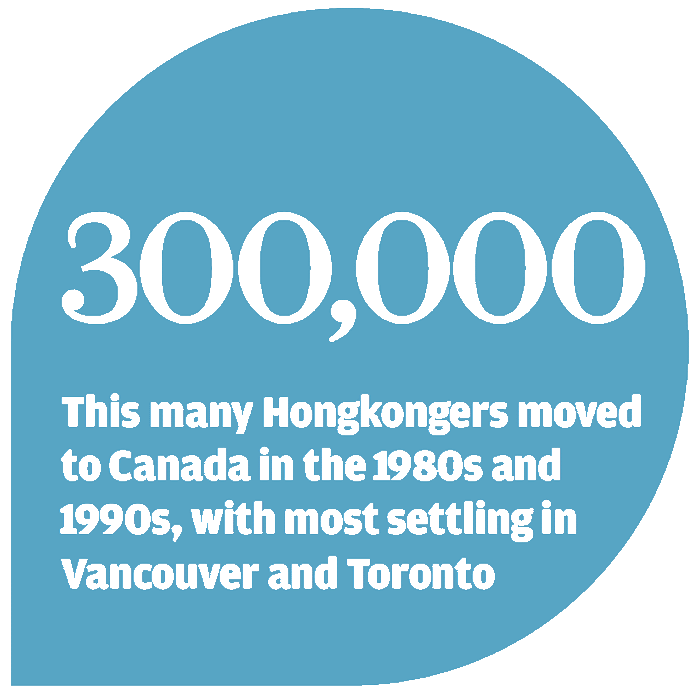
Vancouver has been shaped by waves of Chinese migration. Mainlanders now dominate, but in the 1980s and 1990s it was Hongkongers, many fearful of the handover, who transformed the city. The vast majority of the 300,000 Hong Kong residents who moved to Canada in those decades settled in greater Vancouver or Toronto. But tens of thousands eventually returned to Hong Kong to work, dividing their lives with partners and children back in Canada.
Tse, a doctoral student at the University of British Columbia's school of geography, said the situations that he encountered in his research reflected the experiences of those in his social circle.
"I had friends who were in these living arrangements," he said. "They suddenly found that they had a parent who would come home and they didn't know who this parent was, this guy who had this frozen image of them as kids. Suddenly, they were getting free advice from their dad that would have applied to them as a 12 year old, but they were 22, 23, 24 years old."
The study was based on interviews with dozens of children of astronaut parents over a 10-year period in Vancouver and Hong Kong, ending in 2010. "Katie" told the interviewers: "When I first came [to Vancouver], the first two years I cried a lot". "Jason" said he felt little attachment to his father. Hong Kong was described by "Jeremy" as a place where people "attack you mercilessly … and tend to show off". "I can't stand the competitiveness [of Hong Kong] … I would not survive," said "David".
Tse and Waters found that children of astronaut parents "often perceive [their parents] as inconsistent, fragmentary interruptions in their otherwise independent lives". The arrangement "changes the character of intra-family relations", they found.
Danny Kuo, who was not part of the study, said a burden of responsibility fell on his elder brother's shoulders when the family moved from Taiwan to Vancouver in 1992. Danny was 13. His brother, then 15, spoke acceptable English; their mother never learned the language.
"He would do most of the stuff around the house, dealing with the government and that sort of thing, and I think that kind of damaged the relationship at the time, between my brother and my mother," said Kuo. "There was a lot of responsibility."
Kuo said that even as a child he understood why his father spent most of his time in Taipei, visiting the family only once a month despite having officially migrated with them.
"I accepted the fact. Someone has got to make a living, and pay for our lifestyle," Kuo said. He added that his father was a strict disciplinarian; he felt at the time that his life actually improved when they were separated.
"My Dad, he didn't believe in anything less than perfect, so for me, there was no more ass-kicking … I was still getting straight A's in school, so when my father comes home he just sees my marks [and] he doesn't want to be a bad guy," said Kuo.
The extent of the astronaut arrangement is uncertain, but a 2007 study by the Chinese Canadian Historical Society of British Columbia found that two-thirds of male Hong Kong migrants (aged 25 to 44) actually lived and worked outside Canada.
In 1991, 40 per cent of Hong Kong migrants in Vancouver were at some stage part of transnational families, according to a study by Success, an NGO that helps immigrants.
The CEO of Success, Queenie Choo, agreed that about half of ethnic Chinese immigrant families probably used the astronaut arrangement. "It's nothing new," said Choo, 56, who moved to Britain to study at the age of 18, then to Canada by herself in her early 20s. "I missed my parents a lot, but on the other hand I was glad to have my independence. I adjusted."
But some do not.
Choo said that while the children of Vancouver's astronaut families could seem privileged - "I have seen them, kids in these fast cars, and you know the money is not coming from their own pocket" - she also felt sorry for them. "It's not just about the material ... no one can replace your parents," she said. "These living arrangements, maybe they provide a shelter, a place to stay, but that does not make a home."
Tse said there was a consensus among researchers that few people migrate intending to become astronaut parents, but only choose to do so after economic challenges become clear. "There is this idea that maybe the money will hold the family together, but the reality, the emotional reality, is that money doesn't hold emotions together," Tse said.
Tse said collective memories of traumatic upheavals in Chinese history triggered a desire to migrate - "That was especially pronounced after Tiananmen Square" - but breadwinners struggled to find good jobs or business success.
Illustration: Sarene Chan"People calculated: we have to go somewhere," he said. "But then they got here [Vancouver] and discovered that they couldn't [find] work, or that Canada's business immigration programme was not ideal. They have to pay higher taxes. They can't replicate their business model from Hong Kong here.
"This is where they make this calculation [for the breadwinner to return to Hong Kong]. But the money has to stay within the family … within the Chinese ideology - 'So long as the money stays within the family then our family is together'."
He described the astronaut arrangement as an attempt to maximize a family's "economic prowess", by securing the safety net of a foreign education and nationality for children, while maintaining parental earning power. Co-author Waters, an Oxford University lecturer in human geography and fellow of Kellogg College, said an emphasis on the importance of education was a driving force. "An English-medium education continues to be prized in East Asia," she noted.
However, parents risked underestimating the negative impact of the astronaut arrangement, both emotionally and in terms of academic success. "Research is increasingly suggesting that, in many cases, it is not worth it," Waters said. She went on: "My own research on families from Hong Kong and Taiwan has suggested that households are put under tremendous strain and that, as a result of split family arrangements, children develop strained and negatively impacted relationships with their parents."
Astronaut parents, she said, "clearly want the very best for their children, but children are complex beings with emotional as well as material and educational needs".
Kuo certainly did not lack materially when his mother, after six years in Vancouver, moved back to Taiwan. Kuo's brother was already studying medicine in Montreal. "When I graduated high school, it was like, 'My work here is done'," Kuo said of his mother.
Although his parents visited regularly, Kuo set about making the most of his freedom. His social circle consisted of former school friends unburdened by the demands of pre-med study. His academic results plunged.
In Kuo's words, "one thing led to another". In 1999, he and some friends attacked someone - "We beat that guy pretty bad" - and Kuo was convicted of assault with a weapon. A first-time offender, he pleaded guilty and was put on probation, his record eventually expunged.
"I was this perfect kid," Kuo said as he recounted this life-changing experience. "I had this spotless record, you know? A UBC pre-med student. I had 40 or 50 people giving me these character references."
Kuo said he gave up his old lifestyle and became a committed Christian. He moved to the Philippines to complete his medical studies at the insistence of his father, but later returned to Vancouver. After a long process of study and certification, Kuo is now a medical resident in nearby Victoria. His father passed away in Taiwan in 2007, and his mother, now 64, moved back to Vancouver.
Tse and Waters found that despite a parental expectation that children might want to return to work in their homeland, many forged strong bonds with Vancouver and Canada. Their interviewees cited Vancouver as a leisurely place, in contrast to Hong Kong's "alienating hostility".
Such attitudes could have substantial policy implications, as governments try to anticipate migration patterns, the study said. Tse said that the next question for the adult children of astronaut families was whether there is a place for them in Vancouver's economy.
"In the literature, there is this assumption that, 'Of course the young people will want to go back there [to HK or greater China]', but if you talk to the young people there is no 'of course'," he said.
Tse and Waters urged parents to talk to their children before embarking on the astronaut lifestyle.
"Have your political and economic calculations," Tse said. "But within that, factor in what your kids are saying. When you're talking to an 11 or 12-year-old you're not after a rational opinion, you just want to find out, 'Well, how would you feel if Dad was in Hong Kong'."
"[Parents] must realise that their relationship with their child will inevitably be affected if they leave their child abroad and the child may resent this for a long time," Waters said.
Married for five years, Kuo and his Taiwanese-born wife hope for children of their own. He said he would never impose an astronaut arrangement on them. "Definitely not. I couldn't do it," he said. "I would not want to be separated from them."
But he insisted his father's choices and sacrifices were in the family's best interest. "I don't know how my Dad did it; he was a great man. It was definitely the hardest on him. He's the one who took the responsibility."


Legal Troubles
Impounded sports cars used for illegal street racing. Photo: CBCThe children of well-off astronaut families appear to have everything going for them, but they are sometimes in the spotlight for the wrong reasons.
THE FAST AND THE FURIOUS
One afternoon in August 2011, 13 young drivers decided to use Vancouver's Highway 99 as a drag strip.
Driving Ferraris, Lamborghinis and other high-end sports cars worth a total of C$2million (HK$14.74 million) the racers blocked other drivers to allow friends to speed alongside each other at up to 200km/h. Most were in their teens and all were under 21, according to media reports.
The drivers were presumed to have astronaut parents: the few names that were released were Chinese, the drivers appeared East Asian, and several were identified as students of elite St George's boarding school. The school released a statement that pointedly did not deny the claims. One Audi R8 boasted a lucky "888" number plate.
Although C$196 fines were the maximum allowed, the lesson proved more expensive for some of the boys (or their parents). Four cars were confiscated under laws allowing seizure of assets used in unlawful activity.
FATAL VISIT
Guo Lianjie and husband Tang Jihui flew to Vancouver in May 2012, for a reunion with their son, Tang Yuanxi, who had been studying at community colleges for six years.
But the day before their return flight to Guangdong, Guo vanished. Two weeks later, the slight bespectacled son appeared distraught alongside his father to beg for information about her whereabouts.
But police say Tang Yuanxi murdered Guo and packed her remains in a suitcase that washed up on a distant island. Tang is also charged with conspiring to kill his father. Police have not commented on a motive. A trial is scheduled for next year.
MY DAD, THE TRIAD
The most notorious astronaut family in Vancouver is that of Lai Tong Sang. The infamy has nothing to do with the behaviour of his son and two daughters.
Authorities allege Lai headed the Wo On Lok triad when the young family migrated in 1996 amid a gang war with "Broken Tooth" Wan Kuok-koi. Triads hired to assassinate Lai shot up the family's Vancouver home in 1997.
This year, immigration authorities had Lai's residency revoked. His whereabouts remain unknown, but he is not believed to have lived in Canada for many years. He participated in this year's immigration hearing by phone from Macau. His wife and children were allowed to stay in Canada.

 http://www.scmp.com/news/china/article/1364563/children-rich-chinese-home-alone-canada-face-challenges

Friday, November 1, 2013

Por Por’s Cookbook

Tuesday, 29 October 2013
Por Por’s Cookbook

Ever wondered how to make Cantonese style 1,000-year-old pickled duck egg? Is there a difference between this and salty duck egg? What’s the Cantonese word for black-eared fungus? Lynda travels to Ashburton in the South Island to check out Por Por’s Cookbook, exploring the life stories and recipes from 15 Chinese grandmothers across New Zealand. Literally hot off the press, this brand-new publication by editor and author Carolyn King (nee Wong) is a sumptuous fusion of oral history and recipes handed down through the generations between mother and daughter from old Canton in Southern China to present-day New Zealand.
Gallery: Por Por's Cookbook
For more information about Por Por's Cookbook email carolynking@clear.net.nz

Asian Report for 29 October 2013 - Por Pors Cookbook ( 11′ 50″ )

15:33 Lynda Chanwai-Earle is in Ashburton to meet the author of a unique publication, 'Por Pors Cookbook'. It's literally hot-off-the-press and contains a collection of recipes and stories from Chinese grandmothers across New Zealand.

Monday, September 23, 2013

Second Burial, NZ Chinese Experience 1883 and 1903

'Newsletter Tauranga West Coasters Association
vol 9 no5"


A book, "Second Burial, NZ Chinese Experience 1883 and 1903" written by Helen Wong and
published recently is of interest to Coasters.   Chinese goldminers came to NZ hoping to find
riches and then to return home. Many died here and the Chinese believed that that after death the
soul hovers over a grave. If a Chinese man died in a foreign country his soul would be homeless
and unable to rest until his body was shipped back to China. Local newspapers in 1883 reported
that bodies were being removed from the Greymouth and Reefton cemeteries. Again in 1901
the exhumation of Chinese from 40 cemeteries around the country saw the remains cleaned,
washed, wrapped in linen and placed in watertight zinc coffins which were soldered shut. The
steamer Ventnor left Dunedin with 263 coffins, picked up 173 in Greymouth and a further 86 in
Wellington. The steamer was bound for Hong Kong but tragically it struck Cape Egmont and
foundered with the loss of all coffins. The steamer Energy was employed to locate the wreck and
recover the bodies but very few were found.

Friday, May 24, 2013

Ventnor Trail Part 1


http://podcast.radionz.co.nz/aft/nzsociety-20130524-1420-nz_society_-_the_ventnor_trail_part_1-00.ogg

S.S. Ventnor Historical Trail

The Radio NZ Documentary about the S.S. Ventnor Historical Trail and the very memorable road trip to the far North to commemorate Ching Ming will begin broadcasting tomorrow afternoon from 2:30pm on the Afternoons Programme with Jim Mora.

This is a four part documentary, so each 12 minute segment will broadcast at the same time each Friday over the next month as follows:

Fri 24 May, 2:30pm: Part 1 – 499 Hungry Ghosts

This opening programme introduces the history, the powhiri at Te Roroa HQ and the Bei Jey ceremony at Kawerua Beach.

Fri 31 May, 2:30pm: Part 2 – Bei Jey, what about aspects of Tapu?

This segment focuses on discussing difference in cultural rituals with members of our community and Kaumatua Alex Nathan from Te Roroa Iwi during the Bei Jey ceremony at Kawerua Beach.

Fri 7 June, 2:30pm: Part 3 – the pilgrimage to Mitimiti

This segment focuses on travelling to Mitimiti, the powhiri at Te Matihetihe Marae and the unveiling of the Red Gate Plaque

Fri 14 June, 2:30pm: Part 4 – Appeasing ancestors

This segment focuses on interviews with the descendants of Choi Sew Hoy, the Skipper who fishes off the Ventnor wreck and Wong Liu Shueng on appeasing our ancestors.

If you miss the live broadcast you will be able to listen the podcast after it has been posted by going online to our website www.radionz.co.nz

Saturday, March 30, 2013

Second Burial: New Zealand Chinese Experience 1883 and 1902

Second Burial: New Zealand Chinese Experience 1883 and 1902 - Researched by Helen Wong
ISBN 978-0-473-24298-5


The Cantonese custom of secondary burial, the idea of exhuming the dead, cleaning the bones, and then burying them again, helps to explain why so many (overseas) Chinese were not only willing to exhume their dead but also to clean the bones and put them in containers for shipment back to China. * Reburial: Exhuming the Dead and Returning Them to China http://www.cinarc.org/Death-2.html#anchor_14

There were two periods of mass exhumation of Chinese in New Zealand, organised for the Panyu people, by the Dunedin Sew Hoy family.

In 1883, 286 Chinese from the South Island were repatriated on the Hoi How.

And in 1902, 499 were aboard the ill fated Ventnor when it sank 10 miles off the Hokianga Heads. This time Panyu men from both the South Island and the North Island were included, as well as eleven Wellington men from the Jung Seng county of China.

helen.familytree at gmail.com

To purchase email helen dot familytree @ gmail.com

Wednesday, February 6, 2013

Chinese in Dunedin 1905

We have received from Mr Wong Tape a cheque for £25 3s Ocl, collected from Chinese residents, for the Hospital Extension' Fund. The following is the detailed list:—Toons Lee (gardens) 10s Cd, Hip Fong Tie 10s Od. Yo"g King Yin IDs Gd. K.wo".ig Lee (gardens) 10 s Gd. Ycung Sum 10s 0:1, Dsniel Ynt T<ce' 10.5 Gd, Wall Sang 10s ;Gcl. On Lee (ccok c llop") ]os. Pe'er Ah Chew 10s,' Yip Chong IDs, James Cliin Sing 10s, Sun Young Ghong 10s, Joe -Ciiing 10s, Chik Kmig 10s.' Kum Yo'm Leo 10 s, Leong Man 10s. Joe Say 10s, Foil Han Ying us. Yip Chan ss, Paiil Chan os, Clian Tuck Pon ss. Chuee Lee ssr Tung AYali 59, Key. "Villi-m Chan ss. Jfathev; Chin;! Hoy ss, C. Hon Yep ss. See Wall ss, Joe Bun ss, Joe Kill ss. Wong Tuck ss. Wong Sni liun ss, Wong Hak ss, J. Chuie Kum ss. Wong Kew ss. Shu Shee ss. Ng JJoii ss. Wong Mo ss, Y'eung Yuen ss, Shu Yon ss, Wong Toong Yow Ss. Toong Quon ss. Jvoo Choo ss, Kwok Man Cheuk' ss, Wong Chung "i'ee ss, Ciini Ting Choy 4s. Yeung La; 3s, Chan Yun Kv.-ee 3s, Yeupg Kum 3s, Chi Chi Hoy 3s, Leong Yut Chong .is, Ho Yee'fiip 3=" Chafi Sang ."s, Lqong ICwai Lun 3s, Wong Kung 3s, Tommy Joe 3s. Wong Sing 2s Gd, Laii Hihg Si fid, Chin Fo?i 2s Gd,' "Ping Quong 2s 0:1. Ycung Kuiiii '2$ Gd, Wong Yau Foon 2s Gd, Ho Yiipg
Sing 2s fid, Yeung Wing Tin 2s Gil, Young Kui Liuig 2s (id, Tso Kvyni 2s Gd, Soo Kee 2s 'Gd, Wong Ham 25,6 d, Chui Yung Kiirn 2s Gd, Tso Sing 2s' Gd, Yip Bor 2s pel, Wong' Yeo 2a Gd, Lai Won Hoy 2s Gd, Lee Sun 2a Gel, Chi Hon 2s Gd, Chung Nam 2s (id, Wong King 2s Gd, Clia'n Sai On 2s Gd, Soo Chou Yait 2s Gd, Chang Sui 2s Gd, Paiig Yun Cliueii 2s Gil, Soo Muk Siiin 2s Gd, 0. Ben Sing 2s Cd, l'so Plug Sing 2s Gd. Tso Ho 2s Gd, Cheong Kwoug 2s Gd, Wong Tan 2s Gd, Wong Looug 2s. Yjp Bun 2s, Wong Sik Tang 2s, Kwok Cheong Ycong 2s. L;ui Lut 2s. Ng Ping 2s, Tun Hung 2s'. Yip Lin Tai 2s. Fung Pak 2s, Soo Tai 2s, ToongLock 2s, Joe How 2s, Wong Nga. 2s, Tso Ngn't 2?, Yip Yin 2s, Chan Moon 2s, Soo Chong 2s, Wong Hoong 2s, Lui Kg 2s, Chang' Tin 2s. ,Wco Sang 2s, Geo. Weo 2s, Wong Foon 2a, Wong Hin' Kwong 2s, Wong How Ting 23, Chan ice 2s, Chan Yung Kee 2s. Soo Ho Yaii' Ssj Wong jo Ching "2s, Wong Cluing Yow 2s, Ycung Chin 2s, Ts'e Wai Is Gd, Ho Chin la Gd. Yip Ko Is, Lau Fool; Is, Yenim Chung Is, Chan Choy Is, Tse Chan Is, Chi Ping Is, Choy Cheong' Is, Tse Shing Is. B. Wong Tape'lOsGd;—total, £25 3s Gd. Otago Daily Times , Issue 13449, 24 November 1905, Page 4

Tuesday, January 1, 2013

Mr. George Sang,

SEARCHING FOR A POLITICAL  BLUE-BIRD.  Now, it happened the other day that the "Square Deal" Party got to Taumaranui and was met with all sotfts of requests to all of which was given ''that jocular phrase of 'Oom Bill-" A Square Deal." To the many requests "Truth" need, not refer, but there was one, and as it comes from the Auckland "Herald" there should the no need of its veracity. The "Herald" reports as follows:— Mr. Shortland introduced Mr. George Sang, an educated Chinaman and highly-respected citizen of Taumaranui who wished to bring over to New, Zealand his wife and child, and two nephews from China. The Prime Minister said if Mrs. Sang paid the poll-tax and passed the education test she would be admitted. Mr. Shortland thought that m the circumstances the conditions should be dispensed with. Mr. Massey said the matter would bo looked into. Miv Shortland, "Truth" might mention, is a local lawyer, otherwise some people might want to know why Mr. Geo. Sang, an educated Chinkie. etc., didn't ask for a "Square Deal" of his, own accord. In the face of things/ however, Lawyer Shortland has some assurance; m -fact, "Truth" doesn't hesitate to declare that Mr. Shortland, m making such a request of the Price Minister, has a pretty' tough cuticle. Why should Mrs. Geo. Sang and his child and two nephews, be admitted free of the poll-tax, ,and all conditions dispensed with? Why could not Mr. Massey have saild at once that  

THE THING WAS IMPOSSIBLE;
that we have too many Chinamen as it is in the country, and that there would be no general regret expressed if the Chinaman m New Zealand took up his capital and, allowed himself to be driven out. "Truth" doesn't quite follow Mr. Massey. How does he propose to have the matter looked into? Does he propose to ascertain if there is a way of defeating the excellent provisions of our immigration laws? Is the great statesman finding himself up against treaty rights, or is it that' he Is not capable of giving, a straightforward answer? "Truth" wonders! It will be an exceedingly sorry day for Mr Massey Whenever he sets out to set at nought our White Now Zealand policy. This matter, on Mr Massey's promise, wants watching. NZ Truth , Issue 411, 10 May 1913, Page 4